There was something wonderfully cheeky about Round the Bend!: instead of pretending children’s television was polished, educational and safely supervised, it shoved the whole business underground. Literally. The programme presented itself as a video comic being made in a sewer, where a bullying crocodile and three rat employees attempted to keep the show moving while chaos repeatedly got in the way.
That premise gave the series its best joke before anyone had even started a sketch. Television was being produced by creatures who looked as though they had been rescued from a blocked drain, and somehow they still had deadlines, performers, news reports and an artistic department. It was a brilliantly grubby setting for a children’s programme.
In this featureJump to a section
What you need to know before going round the bend
- Broadcast: Children’s ITV, generally dated from 6 January 1989 to 7 May 1991.[2]
- Run: Three series and 18 episodes, with six episodes in each series.[2]
- Production: Made by Hat Trick Productions for Yorkshire Television.[4]
- Creators: Tony Husband, Patrick Gallagher and Mark Rodgers, the creative team behind Oink!.[3]
- Format: Puppet linking scenes mixed with animation and live-action material.[3]
From Oink! to a sewer full of television
The series grew from the same creative partnership that had devised the irreverent children’s comic Oink!. When that comic ended, Round the Bend! emerged “out of the ashes” of it, carrying the earlier project’s anarchic attitude into a television format.[3]
That connection matters because this was not a conventional puppet sitcom with a tidy cast learning a lesson by teatime. The programme behaved more like a comic that had escaped its pages. It could jump from a puppet exchange to a cartoon, then veer into live action or a parody of another television format. The deliberately mixed-up construction was part of the fun: the sewer was not merely a setting, but a production office, studio and backstage panic room all at once.
Its creative team included cartoonist and designer Patrick Gallagher alongside Husband and writer Mark Rodgers, while Hat Trick supplied a television-comedy environment rather than a traditional children’s-show machine.[3] The result felt knowingly homemade without being careless. It understood that a child could enjoy a daft puppet while also spotting the familiar television formula being sent up.
Meet the workforce: Doc Croc and the rat pack
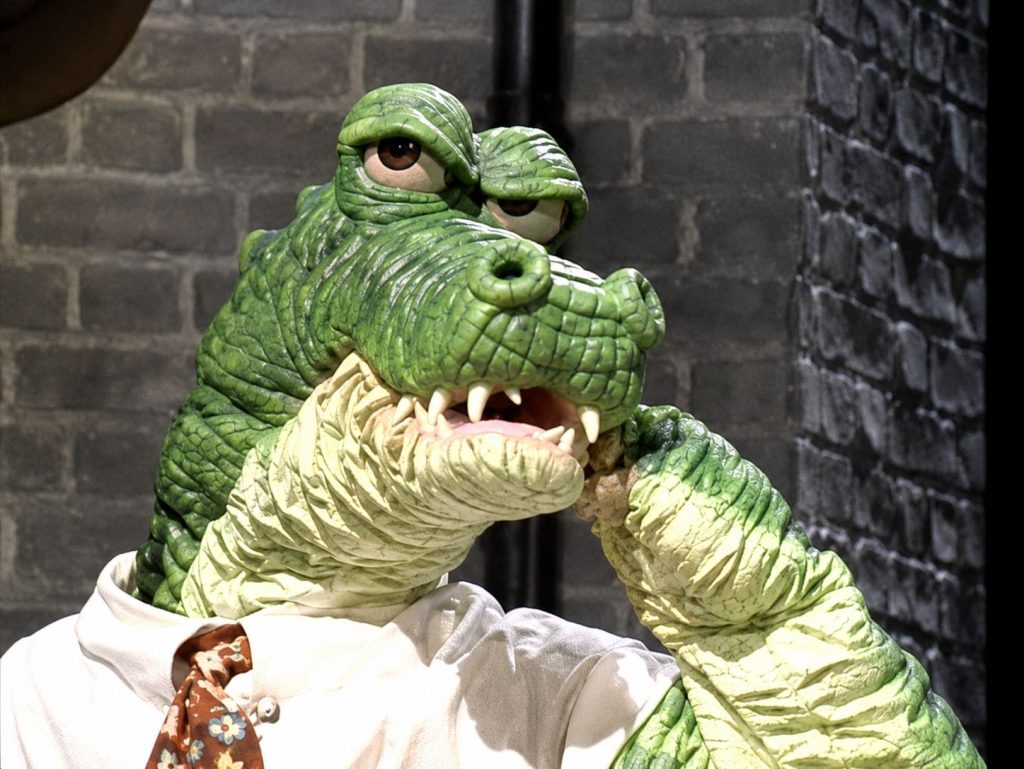
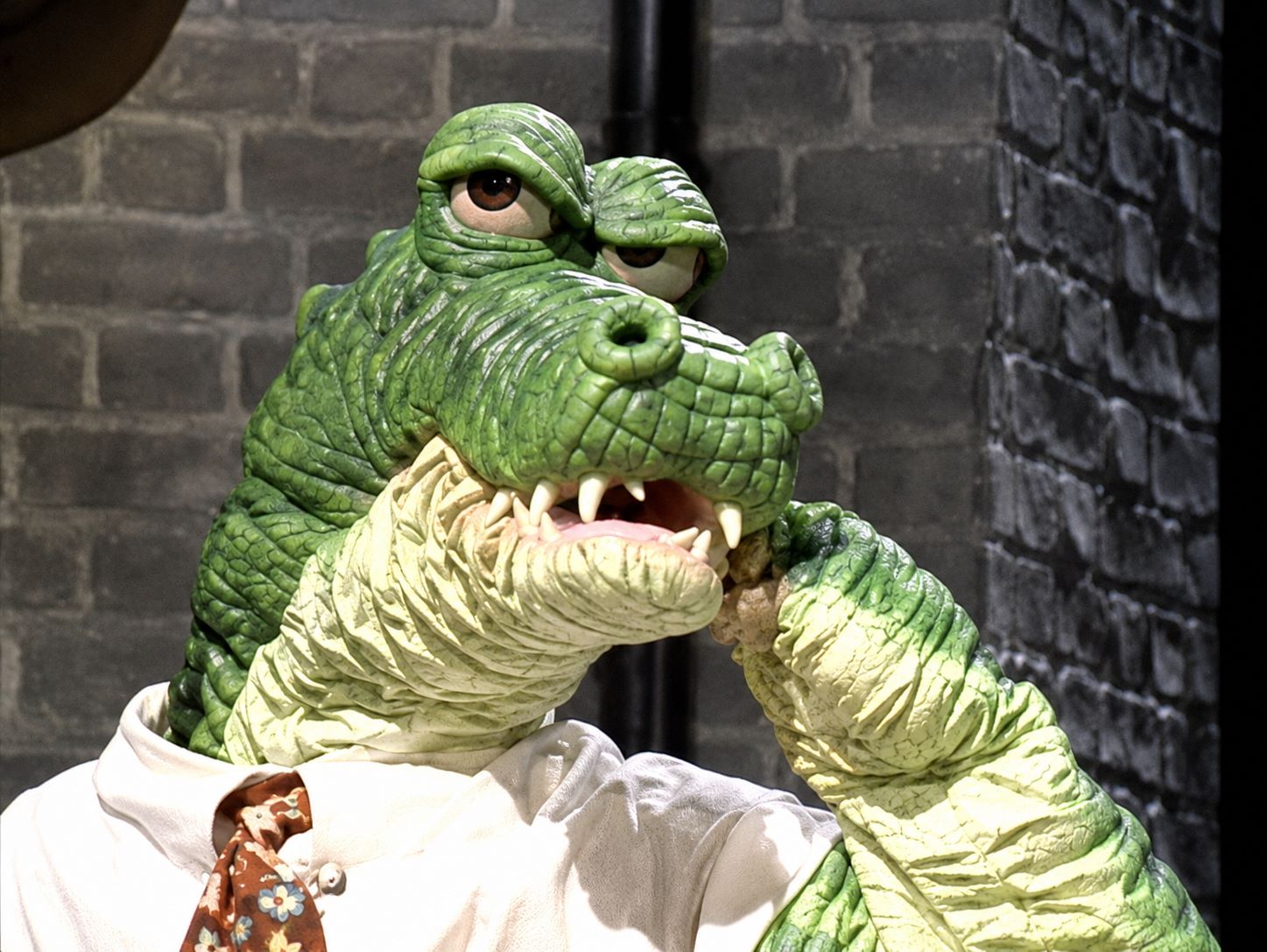
Doc Croc is the boss, which is bad news for everybody else. He is a bullying crocodile presiding over the sewer operation, and his employees are the rat characters expected to supply the jokes, drawings and reporting while presumably receiving very little in the way of workplace support.
Jemima Wellington-Green is the reporter, Vaudeville Vince Vermin is the relentlessly optimistic comedian, and Luchetti Bruschetti is the put-upon resident artist. The last of those names is also known through the visual gag “Lou Brush”, the sort of pun that arrives wearing a small hat and refuses to apologise for itself.[4]
This arrangement gave the show a useful comic engine. Doc Croc could bully, Vince could perform, Jemima could report and Lou could draw, allowing the programme to parody the machinery of entertainment as well as the entertainment itself. It is difficult to imagine a more accurate office hierarchy for a television production: one unreasonable manager, one performer who refuses to lose heart, one person trying to make sense of events and an artist quietly being handed another impossible brief.
When children’s television became the target
Round the Bend! did not have to invent an elaborate fantasy world when television already offered so many ripe targets. Its recurring material included Wee-Man and the Masters of the Looniverse — also recorded in another form as “Puniverse” — along with Thunderpants.[4] The titles alone explain the general approach: familiar pop-culture language was given a cheap wig, a silly name and a firm shove down a drain.
The first episode reportedly packed in Tony Robinson, the Oddbod Family, Transformaloids, Pzycho the Magnificent, John Potato’s Newsround and David Colemole’s Sportview.[2] That list is a miniature mission statement. News, sport, superheroes, celebrity appearances and cartoon families all became ingredients in the same comic stew. Rather than presenting television as a magical box, the show encouraged viewers to recognise its tricks and laugh at the costumes.
There is a particular pleasure in a programme that treats a news parody and a character called John Potato as equally respectable forms of broadcasting. The jokes were aimed at the formats children already knew: presenters announcing things with unnecessary seriousness, heroic figures striking poses and entertainment packages behaving as though they were much more important than they really were.
A scruffy production with serious comic instincts
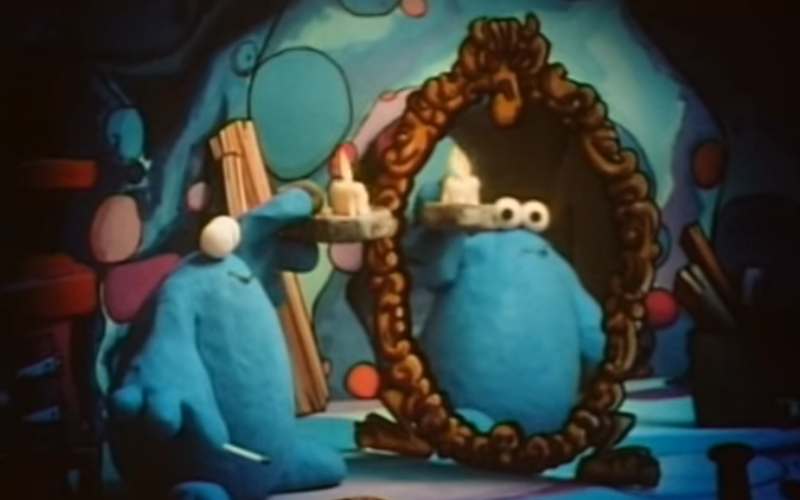
The visual mixture was central to the experience. Puppet scenes established the sewer workplace, while cartoons and live-action inserts could suddenly expand the world beyond it.[6] That contrast helped the programme feel like a comic magazine brought to life, with each section allowed its own texture and rhythm.
There was also a notable overlap with the wider British comedy scene. TVARK credits Hat Trick figures Jimmy Mulville, Rory McGrath and Geoffrey Perkins as part of the script-editing team, and notes that performers associated with Spitting Image worked on the puppets.[5] That helps explain why the puppetry could be both character-based and satirical: these were not simply cute mascots waiting for a catchphrase, but figures built to mock the business around them.
Of course, the roughness will not suit everyone. The jokes can be noisy, the puppets are intentionally unglamorous and the barrage of invented programmes occasionally feels like a box of props being tipped down a staircase. But tidiness would have ruined the point. Round the Bend! was funniest when it looked as though its own sewer studio was only just surviving.
Why it still deserves a rummage
The series ran for only 18 episodes, yet its format gave it a larger-feeling playground than a straightforward sketch show. Doc Croc’s sewer, the rat employees, the cartoons, the live-action intrusions and the parodies all worked together as one big joke about making television.
That combination has helped it retain a fond place in British children’s-TV retrospectives. In 2023, The Guardian included Round the Bend! among its 50 greatest children’s programmes, describing it as a darkly anarchic spoof magazine show.[6] The programme was even nominated for a Royal Television Society award, according to Tony Husband’s obituary.[3]
It is not a polished trip down memory lane, and that is precisely why it remains appealing. Round the Bend! made children’s television look less like a finished product and more like a mischievous comic assembled by rats, crocodiles and people with access to a puppet workshop. For viewers who enjoy British television at its strangest and scruffiest, that is a sewer worth exploring.