
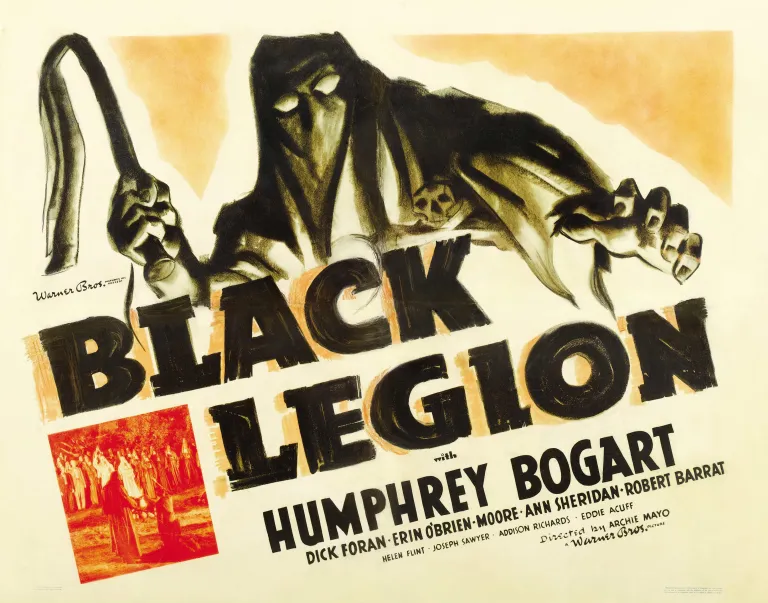
Black Legion is often discussed as a Humphrey Bogart film, but its most striking feature is the way it connects private frustration with organised political violence. Released by Warner Bros in 1937, the film dramatises the rise and collapse of a factory worker recruited by a secretive vigilante movement. Its warning is blunt: extremism does not always begin with grand ideology. It can start with wounded pride, grievance and the promise of belonging.
In this featureJump to a section
A Warner Bros social-problem film
During the early 1930s, Warner Bros developed a distinctive kind of contemporary drama. Films such as I Was a Fugitive from a Chain Gang and Wild Boys of the Road approached social injustice with the urgency of a newspaper exposé. They combined researched subject matter with sensational storytelling, presenting current problems through accessible, emotionally direct cinema.
The studio’s gangster films often occupied similar territory. Although The Public Enemy and Little Caesar were more overtly crime pictures, they shared Warner Bros’ gritty urban atmosphere and interest in social conditions. Even when the studio moved towards faster, more purely entertaining gangster stories, its films retained a hard-edged realism that distinguished them from the more polished styles associated with studios such as MGM and Paramount.
Black Legion returned to that earlier social-problem tradition. It was not simply a story about hooded criminals. It presented political violence as something that could take root within an apparently ordinary community, while also showing how fear and prejudice could be turned into a profitable business.
The real case behind the film
The film was loosely inspired by the 1936 killing of Charles Poole in Detroit. Poole was kidnapped and murdered by a group of robed and hooded vigilantes. The case helped expose the existence of the Black Legion, described in the source material as an offshoot of the Ku Klux Klan.
The organisation’s targets included Jewish and Catholic communities, as well as opponents of President Franklin D. Roosevelt’s New Deal reforms. Its outlook was shaped by the wider atmosphere of European fascism, while its methods relied on intimidation, secrecy and violence.
Rather than reproduce the case as a courtroom reconstruction, the film uses it as the basis for a fictionalised descent. That choice allows Black Legion to focus on the mechanism of recruitment: how an individual can be encouraged to interpret a personal setback as evidence of a larger conspiracy, then persuaded that violence is a form of self-defence.
Bogart plays a man consumed by grievance
Bogart plays Frank Taylor, a factory worker and family man who is passed over for promotion. The job goes to a Hungarian colleague, Dumbrowski, played by Henry Brandon. The disappointment is initially mundane, but Taylor’s resentment grows when the Legion offers him a simple explanation for his frustration and an opportunity to feel powerful.
This was an important role for Bogart, who had mainly been used by Warner Bros in supporting gangster parts before becoming a major star in the 1940s. Frank Taylor is neither a glamorous criminal nor a confident anti-hero. He is a small, anxious man who discovers that a gun, a uniform and the approval of a group can briefly make him feel larger than he is.
The initiation scene captures that transformation. Taylor is forced to take an elaborate oath at gunpoint before being sold the clothing and weapon associated with the organisation. The ritual is absurd as well as threatening, exposing the theatrical nature of the Legion’s authority. Yet Bogart makes Taylor’s submission disturbing because it is rooted in genuine insecurity.
One of the film’s defining images shows Taylor admiring himself in a mirror after acquiring the gun. His posture changes as he places the weapon in his waistband. The moment suggests that the gun has become a prop in a new identity: a way for an ordinary man to act out power that he does not possess in his everyday life.
From personal resentment to public violence
The Legion’s operation is presented as both ideological and commercial. Its leaders use prejudice to recruit members, but they also profit by selling robes and weapons. That combination gives the organisation a particularly cynical character. The language of patriotism and order masks a racket built on fear.
After Taylor joins, the consequences spread through his personal life. The Legion helps drive Dumbrowski and his father from the town, clearing the way for Taylor’s promotion. What first looks like a victory soon becomes a source of further instability. Taylor alienates his wife, damages his friendship with a man based on the real Charles Poole, and eventually loses his job.
The film’s structure is direct and sometimes schematic, but that simplicity suits its purpose. Each compromise makes the next one easier. Taylor’s initial grievance becomes arrogance; arrogance becomes intimidation; intimidation creates circumstances that he can no longer control. The story is less interested in explaining extremism as an abstract political theory than in showing its practical effects on work, family and community.
A conventional ending with an unusually harsh judgement
The final act follows a familiar Hollywood pattern. Taylor breaks down in court and reveals what he knows about the Legion. His testimony provides the film with a clear moral condemnation of the organisation and reinforces the importance of lawful institutions over vigilante justice.
However, the film does not offer a complete escape route for its central character. Taylor is partly remorseful, but he is still taken away to serve a life sentence. That ending is more severe than the resolution often found in crime dramas, where a protagonist’s confession might erase responsibility for the worst act.
Here, remorse does not undo the damage. Black Legion recognises that manipulation and social pressure matter, but it does not use them to absolve Taylor. The film’s argument is that ordinary people can be exploited by extremist movements—and that they remain accountable for the harm they help inflict.
Why the film remains significant
Black Legion may lack the reputation of Warner Bros’ better-known gangster films, and its political speeches can feel explicit. Yet its central idea remains powerful. It shows fascism not as a distant foreign phenomenon, but as a domestic force that can exploit resentment, prejudice and the desire for status.
Bogart’s performance gives that warning its emotional centre. Taylor is frightening precisely because he is not initially exceptional. His transformation begins with an everyday disappointment, then accelerates when a movement offers him someone to blame and a group in which to disappear.
That combination of social observation and hardboiled melodrama makes the film more than a historical curiosity. It is a compact study of how grievance can be organised, commercialised and turned into violence—and of how difficult it is to reclaim responsibility once that process has begun.
Original source: Film review – Black Legion (1937)

