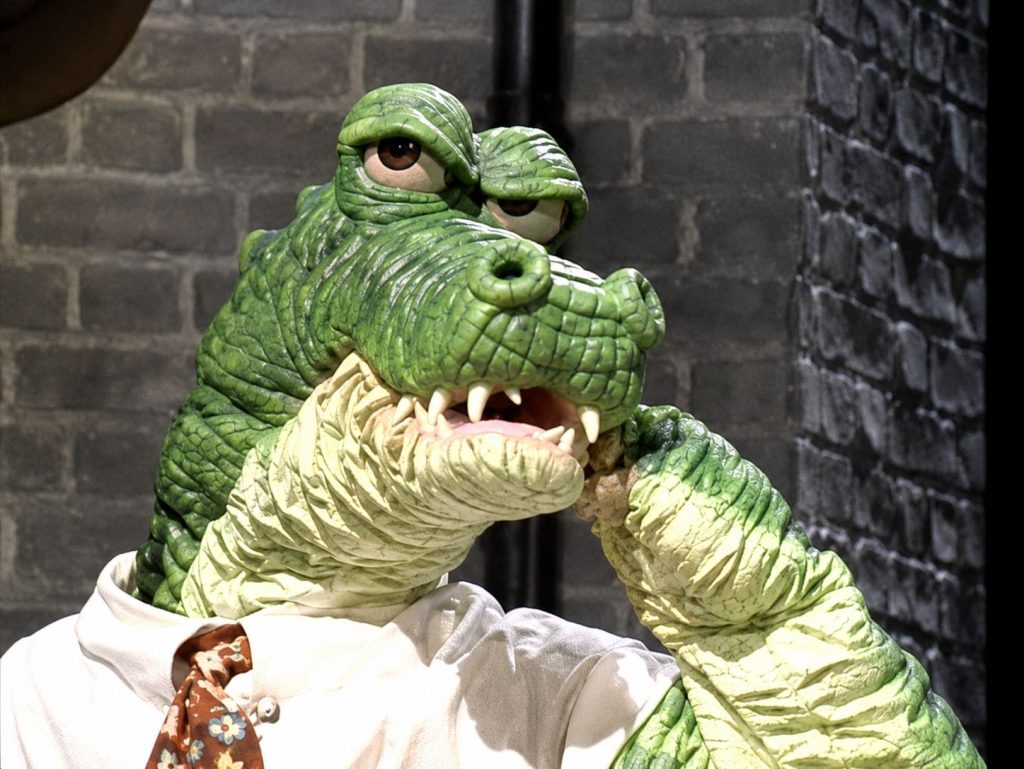
Everything about The Trap Door sounds as though it should be alarming. It takes place in an ancient castle in the “dark and nasty regions”, features a kitchen hatch that absolutely should remain shut, and regularly unleashes worms, bugs and other unpleasant visitors. Yet the series never feels like a proper house of horrors. Somehow, its revolting Plasticine monsters are strangely cosy.
That is the magic of Terry Brain and Charlie Mills’ 1986 stop-motion comedy. Beneath the slime and shrieking is a tiny domestic sitcom: Berk cooks, cleans and tries to satisfy his unseen employer; Boni complains from the comfort of being a disembodied skull; Drutt hunts for something wriggly to eat. The castle may be damp, gloomy and full of suspicious noises, but it has the reassuring rhythm of a shared home where everyone knows precisely who is going to cause the next disaster.
In this featureJump to a section
The important bits, before anything crawls out
- Format: The Trap Door is a British stop-motion animated series from 1986, made in two series of 40 short episodes, generally running for four or five minutes. [1]
- Creators: Terry Brain and Charlie Mills created and directed the programme through CMTB Animation. [1]
- Household: Berk serves the Thing Upstairs, while Boni is a complaining skull and Drutt is a small, worm-loving spider-like creature. [3]
- Voices: Willie Rushton provided the central vocal performance, including Berk and Boni; Nick Shipley is credited as Drutt’s voice. [2]
- Music: Bob Heatlie composed the music and wrote the lyrics for the warning-filled theme tune. [2]
Berk is less dungeon servant than exhausted housemate
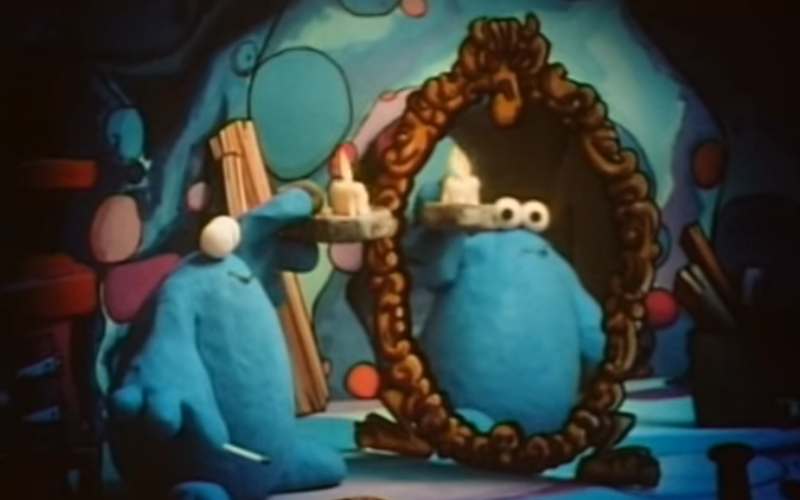
Berk is the programme’s centre of gravity: a rounded blue Plasticine creature with the thankless job of cooking revolting meals, cleaning the castle and responding to orders barked from upstairs. The Thing Upstairs is never properly seen, which makes every booming command feel like a mysterious summons from management. Berk, meanwhile, is left downstairs to cope with the consequences.
That arrangement gives the show its wonderfully lopsided domestic comedy. Berk is not battling evil in a grand fantasy adventure. He is trying to get through the day while dealing with an impossible boss, an argumentative companion and a hungry little pest. The trapdoor is essentially the castle’s worst maintenance problem: leave it alone and all may be well; open it and something will almost certainly arrive to make the cleaning even more disgusting.
Boni brings a theatrical grumble to the household. As a disembodied skull, he ought to be a sinister ornament from a gothic nightmare. Instead, his habitually complaining presence makes him feel like the flatmate who has an opinion about absolutely everything, despite contributing very little to the washing-up. Drutt is smaller, quieter and driven by appetite, with worms occupying a particularly important place in his culinary thinking. Together, the three create a comic balance of tiredness, irritation and gleeful mischief.
The castle is creepy furniture with a family-friendly tenancy
The setting does a lot of work. An ancient castle, a gloomy kitchen and an unseen master provide all the props for a darker monster story, but The Trap Door keeps turning those ingredients into familiar household business. The castle is less a forbidden fortress than a badly managed residence. There are duties to finish, food to prepare and a hatch that keeps making everyone’s evening worse.
The recurring format is simple and very effective: opening the trapdoor, or failing to keep it shut, allows a different creature or infestation into Berk’s domestic world. That gave Brain and Mills a wonderfully flexible toy box. Terry Brain explained that the premise allowed the team to introduce a new character in each episode and experiment with a different style of movement. [1]
So the creatures are not merely villains waiting for a dramatic defeat. They are visitors, nuisances and temporary lodgers. The real pleasure comes from seeing how their strange shapes move, how Berk reacts and how quickly the castle’s residents return to their familiar bickering. Even when the floor appears to be crawling with insects, the effect has the playful ingenuity of a practical joke rather than the cold precision of a horror sequence.
Plasticine makes the monsters disgusting, soft and safe
The show’s visual comfort comes from its material. The monsters were made and animated in Plasticine, allowing them to squash, stretch, writhe and change shape during the slapstick. [1] A creature can look revolting one moment and oddly cuddly the next because its body is visibly soft. The same quality that makes a blob seem slimy also makes it feel touchable.
There is no attempt to hide the handmade nature of the animation. The models have lumps, bumps and an appealing lack of manufactured slickness. Steve Box, who later became an Aardman director and worked as an animator at CMTB, recalled that character performance mattered more than polished smoothness. [5] That attitude is all over The Trap Door: the characters’ expressions, vocal timing and physical reactions matter more than technical perfection.
The production’s improvised solutions add to that warmth. Reported studio methods included using stacked film cans beneath the trapdoor, mixing modelling materials in a coffee jar and making eyes from marbles. [1] Those details make the series feel like a miniature workshop where someone has built a world out of whatever was within reach. It is difficult to feel too threatened by a monster whose eyeballs may have the general visual character of marbles and whose entire body can be folded into a lump.
A warning-filled little world that still works
Some aspects are undeniably dated. The animation is rough, the stories are built around repetition and the sound mix can become gloriously shouty once Berk, Boni, the Thing Upstairs and an invading creature all get involved. The humour is broad, and the idea of serving up revolting food is hardly a recipe for refined dining.
But the roughness is also the point. The programme’s short episodes do not overstay their welcome, and its central routine is sturdy enough to support endless variations. Rushton’s performance gives Berk and Boni distinct comic identities, while the flexible Plasticine models make every new creature feel like an opportunity for a fresh physical gag. The dialogue could also be adapted around the animation: rough replaceable paper mouth shapes allowed Rushton to fit and adjust his performance to the finished pictures, leaving room for spontaneous line changes. [1]
That is why The Trap Door remains such an invitingly odd little show. Its castle contains slime, skulls, worms and things that should probably be reported to someone upstairs. Yet Berk, Boni and Drutt give the place routine. The trapdoor may open onto chaos, but the characters are always there to grumble, wriggle and get on with the next bit of supper.
It is horror furniture converted into household comedy: colourful, lumpy and reassuringly handmade. Just keep the hatch shut. Or don’t. You know perfectly well what happens next.
Sources and further reading
- The Trap Door Celebrating A Much Loved 80s Animated Series – denofgeek.com denofgeek.com
- Fullcredits – imdb.com imdb.com
- Trap Door Intro.htm – clivebanks.co.uk clivebanks.co.uk
- The Animators Playing God.html – ukanimation.blogspot.com ukanimation.blogspot.com
- Aardmans Steve Box Talks – awn.com awn.com